
Many Minds. One Hive. Every Cell Connected
A non‑profit community and environmental project reconnecting people with nature — and with each other.

The gap between policy and the land
This is not an abstract crisis
National decline tells us the pattern.
Local decisions show us the consequences.
The Hive Effect is about turning evidence into repair.
National Buttons


Local Buttons


National Section

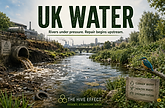
England’s water problem is not just sewage. It is rivers, brooks, drainage, phosphorus, chemicals, modified channels, flood risk and poor catchment management.
The state of UK waters
The Environment Agency’s 2025 evidence says only 16% of assessed surface waters and 14% of rivers achieve good ecological status, while 0% achieve good chemical status when all assessed chemical standards are included.
If national policy says water quality and natural flood management matter, then Sandwell’s brooks, ponds, flood-prone green spaces and River Tame corridors should be treated as environmental infrastructure — not leftover land waiting for development.

Soil is not dirt. It is flood control, food security, biodiversity, carbon storage and water filtration.
The state of UK Soil
The 2025 Environmental Improvement Plan says soil health affects the physical, chemical and biological condition of soil, and commits to bringing 40% of England’s agricultural soil into sustainable management by 2028, rising to 60% by 2030. It also says government aims to improve soil data and establish a soil-health baseline by 2029.
The Environment, Food and Rural Affairs Committee also warned that soil degradation in England and Wales puts around 4 million hectares at risk of compaction and over 2 million hectares at risk of erosion, increasing flood risk and threatening biodiversity, water resources and soil fertility.
If soil is now recognised nationally as a critical environmental asset, then abandoned allotments and community growing land in Sandwell should not be treated as dead space. They are part of the borough’s soil, food, flood and biodiversity resilience.

Tree planting targets are not enough. Survival, aftercare, species diversity, canopy cover, wildlife value and connectivity matter more than press-release planting.
The state of trees and woodland
Natural England notes that the England Trees Action Plan set an ambition of reaching 30,000 hectares of tree planting per year, while the Woodland Trust’s 2025 State of the UK’s Woods and Trees report says woodland creation targets are still not being met and that between 2020 and 2024 an average of only 45% of annual targets were achieved.
Sandwell says it is developing a tree planting plan to plant 15,000 trees by 2030.
Where are the trees? What species? Who maintains them? What is the survival rate? Are they native?
Are they planted where they reduce heat, flood risk and habitat fragmentation?
Are mature trees being protected, or is the council counting saplings while losing established canopy?
A tree strategy is only meaningful if it protects mature trees, connects habitats, survives beyond photo opportunities and is publicly mapped.

Biodiversity decline is measurable and national. Local examples become part of a bigger pattern.
The state of native wildlife
The State of Nature 2023 report says UK species studied have declined by 19% on average since 1970, nearly one in six species are threatened with extinction from Great Britain, and pollinators such as bees, hoverflies and moths have declined by 18% on average.
In England, the all-species abundance indicator has declined to around 60% of its 1970 value, while the priority species indicator has fallen to just under 20% of its 1970 value.
Pollinating insects are also in decline. The UK pollinator indicator showed a 23% decrease in 2024 compared with 1980.
Wildlife does not live in policy documents. It lives in connected places. Once those places are fragmented, drained, fenced, built over or neglected, the loss becomes permanent.
Wildlife decline is not just about rare animals vanishing. It is about the collapse of everyday living conditions: clean water, living soil, trees, flowers, ponds, hedgerows, scrub, grassland, quiet corners and connected routes between habitats.

The state of environmental governance
The Office for Environmental Protection reported in January 2026 that government remains off track to meet its environmental commitments, including key targets for biodiversity and protection of land and sea by 2030.
The problem is not a lack of strategies. The problem is the gap between strategies and delivery.
Local Section

Sandwell’s own climate commitments

Sandwell says it declared a Climate Emergency in 2020 and has committed to being a carbon-neutral council by 2030 and a carbon-neutral borough by 2041.

If Sandwell accepts the climate emergency, why are public green spaces, flood-prone land, wildlife corridors, allotments and community growing sites not being treated as core climate infrastructure?
River Tame, Brandhall Brook and water corridors

The Environment Agency describes the Upper Tame catchment as heavily urbanised, with the Oldbury and Willenhall arms of the River Tame and local canal network. It says all water bodies in that catchment are artificial or heavily modified, and that physical modifications for urbanisation and flood reduction have damaged wildlife habitat.
Sandwell’s own Brandhall page says the woodland and watercourses at Brandhall will continue to facilitate species dispersal across the site and into the wider River Tame Wildlife Corridor.

If Brandhall is part of the River Tame Wildlife Corridor, why is the starting point development mitigation rather than nature recovery, wetland restoration, public access, outdoor learning and long-term community stewardship?
Brandhall Golf Course

Sandwell’s Local Plan lists Brandhall Golf Course as site SH34, with an outline application for a primary school, 190 dwellings, public open space, landscaping and associated works.
Sandwell’s Brandhall update also says the replacement Causeway Green School work includes surveys, ground investigations and limited soft vegetation removal.
Council model: school + housing + mitigation.
The Hive Effect model: school + nature recovery + homes kept to edges + green corridors + community centre + outdoor learning + apiary + food growing + water management + public stewardship.

Brandhall is not just a housing site. It is a 37-hectare environmental question: water, wildlife, flood risk, tree cover, public health, education, access to nature and the future of the River Tame corridor.
Allotments and community growing

Sandwell’s own allotment page says its allotment sites are in high demand and all have active waiting lists.
The draft Sandwell Local Plan says Sandwell had 34 allotment sites providing 1,336 plots, and says the council will support allotments, community gardens, community farming, gardening and orchards.

If Sandwell accepts demand for allotments and says it supports community growing, why are long-abandoned or underused public growing spaces not being audited, restored and handed into community stewardship?
Biodiversity Net Gain

National guidance says biodiversity net gain is meant to require development to have a positive impact on biodiversity, usually at least a 10% increase in biodiversity value, with a Biodiversity Gain Plan approved before development begins.
Sandwell’s Local Plan evidence base includes a Biodiversity Net Gain Strategy, Local Nature Recovery Strategy and habitat assessments.
Sandwell’s main modifications also say proposals offering more than 10% BNG will be welcomed, especially where they strengthen ecological networks and create stepping-stone sites between larger green areas.

BNG must not become a permission slip to damage existing habitat. The question is not just whether a spreadsheet says 10% has been achieved. The question is whether real, connected, living habitat is protected, improved and maintained long term.

Evidence. Stewardship. Repair.
Evidence
The Hive Effect documents what exists, what has been lost, what has been neglected and what decisions were made.
Examples:
-
photographs
-
maps
-
planning documents
-
flood records
-
wildlife sightings
-
tree loss
-
council statements
-
public land history
-
FOI responses
-
community testimony
Stewardship
The Hive Effect argues that public land should not just be “managed” from above.
It should be stewarded with:
-
residents
-
schools
-
growers
-
beekeepers
-
tradespeople
-
ecologists
-
youth groups
-
local volunteers
Repair
Bee Sixty-Eight would be the living example:
-
soil restoration
-
pollinator support
-
food growing
-
beekeeping
-
education
-
water awareness
-
native planting
-
community access
-
practical skills
-
local environmental monitoring

Bee Sixty-Eight is not a side project
It is a prototype for how neglected public land can become climate, nature, food, education and community infrastructure.
The environmental crisis is global, but the repair work is local.
In Sandwell, that repair begins with the land, water, trees, wildlife and people already here.
Free Water
Situated near the River Tame corridor, Brandhall and Bee Sixty-Eight create an opportunity to explore managed water use, natural filtration, rainwater harvesting, wetland planting and monitored water stewardship. With the right design, water could become part of the site’s environmental repair model rather than simply a problem to drain away.
Free Energy
Harnessing energy is a major part of creating a sustainable future. The Hive Effect has the opportunity to make itself fully carbon neutral if it's potential is realised. We may create too much!
Projects like this will never get a foothold unless we act now.
Food For All
Food. We don't need to go into detail about the global food chain but mentioning the cost, the shortage, and the demand is something that affects us at a local level. The Hive Effect can alleviate some of those problems by making fresh produce available to local people who may never have had access to such produce before.
This IS Food For All - so Join In and dig in!
Hands On Education
Every possible way to educate is explored at The Hive Effect, and at Bee Sixty-Eight that education really is evolutionary.
Come into the open apiaries or don a beekeeping suit. Plant a seed or take a cutting. Pick food or make a jam. Get involved here or take our ideas home.
Next Level Education
For the engineers out there, for the inventors and the problem solvers, we have some projects to whet your appetite too. They are all very hush right now but all will be revealed at our launch. It may turn out that you have an idea that is the best idea ever and you want to shout about it. Contact us by pressing the button below.

This Is Permaculture
THE HIVE EFFECT
The Ethics on which permaculture are built:
-
"Care of Earth: Provision for all life systems to continue to multiply"
-
"Care of People: Provision for people to access those resources necessary for their existence"
-
"Set limits to consumption and reproduction, and redistribute surplus"