
Many Minds. One Hive. Every Cell Connected
A non‑profit community and environmental project reconnecting people with nature — and with each other.

The seed site of The Hive Effect
A working community project turning neglected land into public value through bees, food growing, outdoor learning, nature recovery, health, and local stewardship.
Bee Sixty-Eight is a working community project showing how neglected land can become public value again.
It brings together bees, food growing, outdoor learning, nature recovery, health, and local stewardship in one small but important place.
This is not just an apiary.
It is not just a garden.
It is the first visible seed of The Hive Effect system.
A small site with a bigger purpose
Bee Sixty-Eight is a small site, but it carries a much bigger idea.
It is a place where beekeeping, food growing, habitat creation, outdoor learning and community stewardship can work together instead of sitting in separate boxes.
The project starts with bees, but it does not end with bees. The apiary is the doorway into a wider system: soil, water, plants, pollinators, people, skills, health and local responsibility.
Bee Sixty-Eight is designed to show what can happen when neglected land is treated as useful again.
Not as spare land.
Not as forgotten land.
Not as land waiting for someone else to decide its future.
As public value.


Built from land memory, not theory
Bee Sixty-Eight did not come from a report, a strategy document or a marketing idea.
It came from lived experience: from watching public land sit unused, from seeing allotments disappear from memory, from asking why useful places are allowed to decline while communities are told there is no space, no money and no alternative.
The project is rooted in the land around Penncricket Lane, The Billies and the wider Queen’s Highway idea.
It remembers that land has history.
It remembers that communities have memory.
It remembers that neglected places are not empty just because they have been ignored.
Bee Sixty-Eight is a practical response to that history:
a small working site where land can be cared for, used, learned from and shared again.


Growing food, skills, and confidence
Food growing
Raised beds, herbs, fruit, pollinator planting, composting and seasonal growing areas can turn a small site into a practical learning space.
People can see what is growing, understand where food comes from, learn how soil works, and take part in something that changes through the seasons.
Practical skills
This does not need to be complicated to be valuable.
A child planting seeds, an older resident sharing knowledge, a volunteer building a bed from reclaimed timber, or someone picking herbs for the first time are all part of the same system.
Community confidence
Food growing gives people a reason to visit, help, learn, talk and return.
It builds more than crops.
It builds confidence, memory, skill, patience and care.
Learning that happens outside
Bee Sixty-Eight can become a place where learning is visible, practical and alive.
Not every lesson belongs in a classroom. Some things make more sense when people can see them, touch them, build them, grow them and watch them change.
Bees can teach pollination, teamwork, seasons and food systems. Raised beds can teach soil, water, patience and care. Composting can teach waste, decay and renewal. Rainwater collection can teach climate resilience. Wildlife habitat can teach people that nature is not somewhere else — it is something that can be supported on the land around them.
The site can give children and adults a chance to learn by doing.
That matters because practical learning builds a different kind of confidence. It helps people understand systems, not just facts. It shows how small actions connect to bigger outcomes.
Bee Sixty-Eight is designed to make those connections easier to see

A healthier way to use land
Bee Sixty-Eight is not a medical project, but it can still support health.
Good land use can give people more reasons to move, meet, learn, volunteer, grow food, spend time outside and feel connected to something useful. Those things matter, especially in places where public space has too often been reduced, neglected or treated as an afterthought.

A small site can still make a difference.
A path can encourage walking.
A garden can create purpose.
A hive can create curiosity.
A growing bed can create confidence.
A shared task can create conversation.
A quiet corner can create calm.
Health is not only built in hospitals, clinics or services. It is also shaped by the places people live, the spaces they can access, and the opportunities they have to take part.
Bee Sixty-Eight is designed to be one of those opportunities:
a place where land supports people, and people support land.
The seed of a wider route
Bee Sixty-Eight is not meant to stand alone.
It is one point in a wider idea: the Queen’s Highway — a connected route of land, water, wildlife, memory and community value running through six communities.
The site acts as the seed. It is small enough to build, test and understand, but connected enough to show what could happen elsewhere.
If Bee Sixty-Eight can bring together bees, food growing, learning, health, water, wildlife and stewardship on one small site, then the same thinking can be carried further: across forgotten land, damaged corridors, abandoned allotments, public green space and places that have been allowed to lose their purpose.
That is why this project matters.
It is not only about improving one site.
It is about proving that land can be thought about differently.
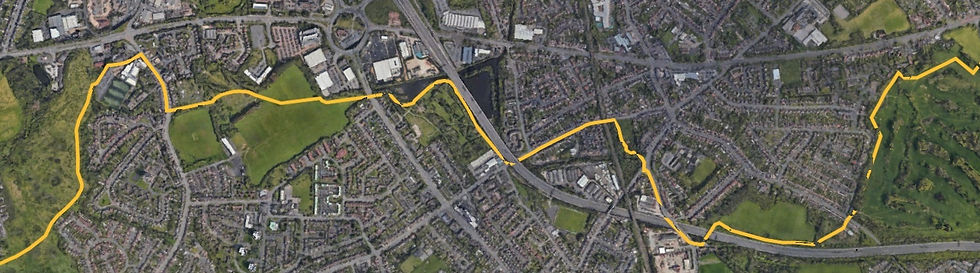
Along its six‑mile length, The Queens Highway binds together the scattered fragments of a once‑united land - fields to forests, canals to hills, families to neighbours, past to future.

Explore the Bee Sixty-Eight vision
What the project can test and build: public viewing apiary, food growing, rainwater capture, habitat creation, reclaimed materials, low-impact systems and practical climate action.


